
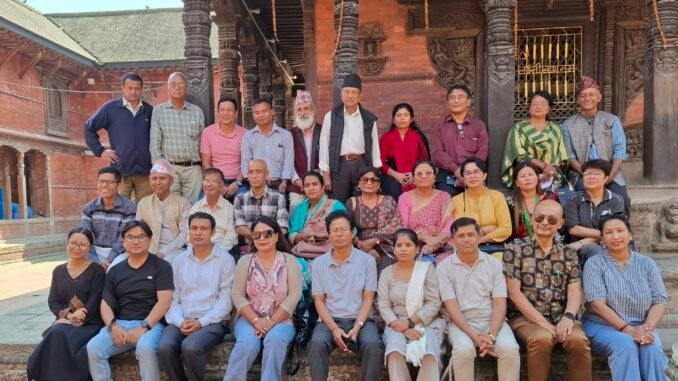

Kathmandu, October 4. A special poetry gathering titled “Mother Tongue Poetry Gathering 2083” has been held at the historic Lakshmeshwar Temple premises in Teku, Kathmandu, highlighting Nepal’s linguistic, ethnic and cultural diversity through poetry. Organized by the Bartaman Kavita Group, in collaboration with the Rato Ghar Foundation and the Nepal Folk Musical Instruments Museum, the event featured poetry recitations in more than nine mother tongues. Poems reflecting diverse languages, accents, cultures and lived experiences resonated through the temple premises near the Pachali Bhairav area, turning the gathering into a celebration of Nepal’s multilingual identity.
The programme began with a welcome address by poet Bishwa Sigdel, a founding member of the Bartaman Kavita Group. He said that a mother tongue is not merely a means of communication but also a foundation of a community’s indigenous knowledge, civilization, collective memory and identity. “Such multilingual literary gatherings serve as a bridge for the preservation and promotion of mother tongues and for bringing literature created in these languages into the national literary mainstream,” he said. Sigdel emphasized that every mother tongue spoken in Nepal carries its own history, culture and worldview, and stressed the need to regard linguistic diversity not as a basis for division but as a source of coexistence and national unity. Original poems were presented in more than nine languages, including Nepal Bhasa, Khas, Tamang, Awadhi, Nepali, Kevarat, Maithili and Sanskrit.
According to the organizers, 38 poets, representing both established and emerging generations, recited poems in their respective mother tongues. The participating poets included Ram Binaya, Jagat Bashistha, Kusu Chhetri, Rehana Nakarmi Manandhar, Bairagi Jetha, Basanta Nakarmi, Sajana Gole, Dr. Anita Shrestha, Shiva Acharya, Sunil Puri, Hansa Kurmi, Rajani Mila, Lumanti Chitrakar, Om Shrestha, Hemanti Kevarat, Krishna Bausay, Balkrishna Shrestha, Subas Mishra, Radheshyam Maharjan, Chaturbhuj Kevarat, Narottam Shrestha, Laxmi Mali, Dhir Kumar Shrestha, Rami Priya, Ishwor Thokar, Amar Kumar Pradhan, Sabitri Shrestha, Ram Prasad Kandel and Navaraj Rayamajhi, among others. The poems, presented in different languages, explored themes including love, nature, culture, social realities, human sensitivity and identity. Participants said that bringing poems in multiple mother tongues onto a single platform was an important step toward strengthening the multilingual character of Nepali literature.
The programme was moderated by poet Chandra Bahadur Lama, a founding member of the Bartaman Kavita Group. Lama said that poetry is not merely an expression of words and aesthetic beauty but also a living document of a community’s geography, history, culture and identity. The programme was conducted in a warm and engaging manner against the historic and cultural setting of Teku, linking literature with the temple, museum, culture and community life. At the conclusion, poet Sneh Sayami, representing the Rato Ghar Foundation, delivered the vote of thanks. Sayami said that programmes that bring creators from different languages, geographical backgrounds and cultures together make an important contribution to the preservation and promotion of mother-tongue literature. The organizers said they would continue literary activities focusing on mother tongues, culture, environment, humanity, identity and contemporary social issues in the days ahead.